
Reviewed · SEOUL K-POP & HALLYU TOURS
K-Pop Making Class with a Producer!
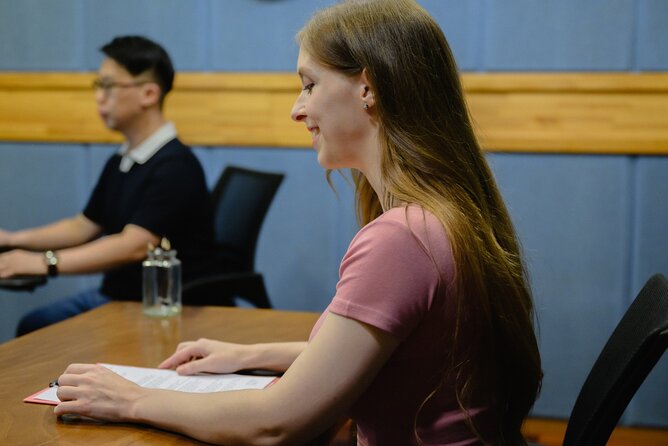
This class turns big K-Pop names into a simple, practical workflow you can actually try in just two hours. I like that you do three roles in one session, singer, producer, and sound engineer, while recording and learning the reasoning behind each step.
What I love most is the language support. You get lyrics with Korean (Hangul) plus romanized text, and there is professional English interpretation, so you are not guessing your parts. The only drawback I’d watch for is that you must arrive at your appointed time, and if you are even a little late you can throw off the whole recording flow.
Key takeaways before you go
- You take on multiple roles: singer, producer, and sound engineer, not just a demo.
- You record, edit, and mix your own song: the work is the experience.
- Lyrics come with both Hangul and romanization: easier than you’d expect for non-Korean speakers.
- English interpretation is included: guidance so you understand what you are hearing and doing.
- You meet in central Gangnam: convenient area, with easy public-transport access.
- Different pack options exist: you can choose the level of output you want.
Finding KING STUDIO near Seolleung, not in the middle of nowhere
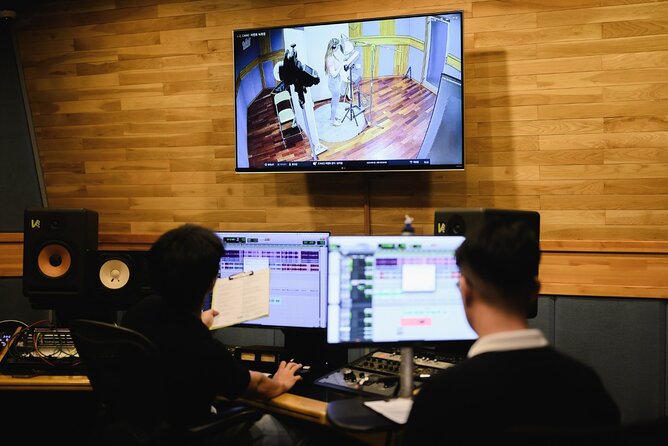
Your session is based at KING STUDIO, a professional K-Pop recording studio. The studio is in the Seolleung area, which is a very sensible base if you want to mix K-Pop culture with normal Seoul sightseeing, since Seolleung connects well around the subway lines.
Here’s the simple way to get there from Seolleung Station on Seoul Subway Line 2: get off at Exit 1 and walk two stops from Gangnam Station on Line 2. Then turn right at Dunkin Donuts, and go upstairs. You are looking for the basement studio entrance in front of a 7-Eleven convenience store. It is the kind of location that is easy once you know what to look for, and annoying only if you arrive without checking your directions first.
You also start your experience meeting around central Gangnam near the COEX Center area. That matters because Gangnam is one of the easiest places to reach quickly from many parts of Seoul. You will likely find your commute less stressful than trying to get to a far-out neighborhood with one tricky bus route.
A few more Seoul tours and experiences worth a look



Two hours that cover the real K-Pop workflow
A lot of music-themed activities are basically show-and-tell. This one is structured around the three key jobs in K-Pop production, and you experience all of them inside the same session.
The roles are straightforward:
- Producer: learning how music decisions connect to communication with sound engineers.
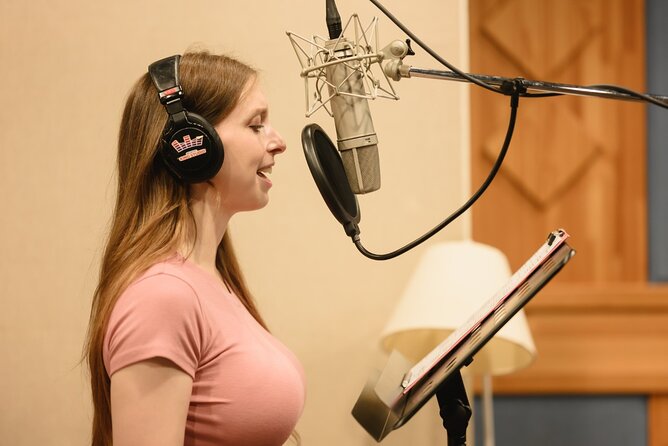
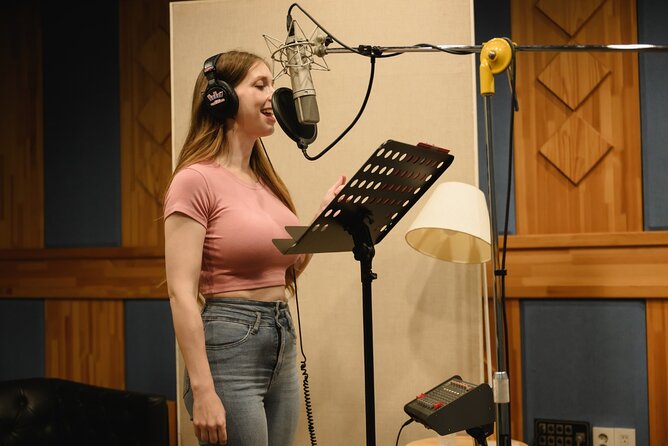
- Singer: recording your vocals using songs that have been selected in advance.
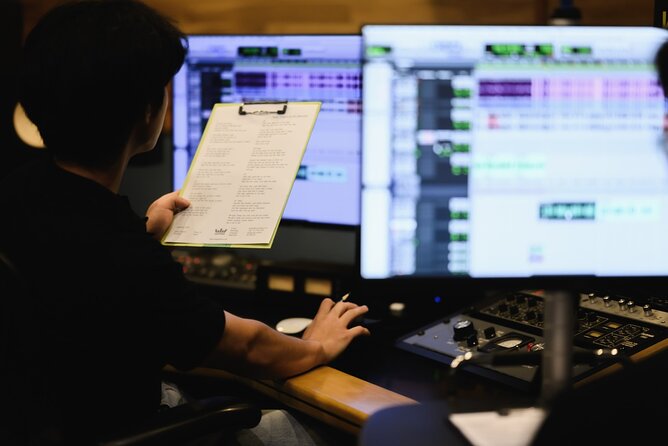
- Sound engineer: recording, editing, and mixing, so you get the technical idea behind the sound.
That triple-role structure is the heart of why this works so well for visitors. You are not just performing. You are also learning how to shape performance into a finished track, and how production choices affect what listeners end up hearing.
In practice, your session is built around a cycle: you get guidance, you do recording and takes, you work on edits, and you move toward mixing. Even if you have never been in a studio before, you get a framework you can remember: performance first, then arrangement and processing, then the balance that makes a song feel polished.
The singer part: recording your vocals with Hangul and romanization
You record songs using pre-selected material rather than trying to assemble a song from scratch in real time. That is actually a good thing for a two-hour class. It keeps the session focused and stops you from losing the best part of the experience to choosing options.
Here is what helps most: the studio provides accompaniment and lyrics, with lyrics in Korean plus romanized text. That romanization is a lifesaver if you can read Hangul only at a glance. It gives you the pronunciation support you need to get through lines confidently, and it reduces the stress that can happen when you are learning something new in front of a mic.
From the guidance side, staff are professional and friendly, and they support your progress step by step. One of the clearest takeaways from customer feedback is that they help you if you want to sing in Korean. You are not thrown into the deep end.
If you care about getting a track that sounds good for your own memory, your best move is to treat the first few takes as practice. Once you hear what works with the recording setup, you will start to sound steadier. That is also when the producer and sound engineer parts start to make sense, because you can hear the difference that editing and mixing choices create.
The producer part: what you learn about sound decisions
The producer role in this class is not about turning you into a chart-topping executive. It is about giving you the thinking behind what producers do.
The key idea: a producer has to understand both music and communication with the sound engineer. In other words, you learn that good production is not random. It is decisions made from what you want the listener to feel, then translated into technical actions.
Even with limited time, the class is set up to show the link between intention and outcome. When you are recording, you are learning how vocal delivery affects the raw audio. When you shift toward editing and mixing, you see how processing turns raw audio into something smoother and more coherent.
This is also where the translator and English interpretation can matter a lot. If you only understand the mechanics without the purpose, studio work can feel like button pushing. With interpretation included, you can connect the why to the what.
The sound engineer part: editing and mixing in a professional studio
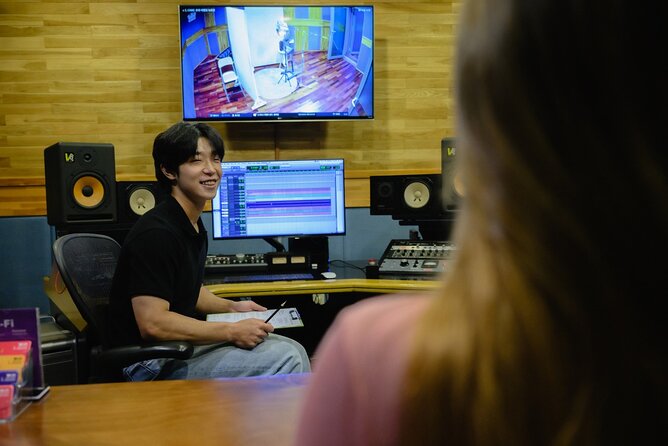
This is the part that surprises people in a good way. You are not just watching someone else work in the DAW. You get the experience of doing recording, editing, and mixing, so you understand the arc of a finished track.
Editing and mixing can sound intimidating, but the practical value here is that you learn what to listen for. Even if you do not leave with a full studio engineering skillset, you leave with better ears. You start noticing how vocals sit in the song, how levels change the emotional impact, and how small adjustments can make the whole track feel more “K-Pop ready.”
Based on the guidance described in feedback, the staff help you through the process and support you while you work. A friendly environment also matters in a studio. If you are nervous, you will not perform well, and you will not enjoy the hands-on technical work as much. The tone at KING STUDIO is described as warm and welcoming, and that helps you stay focused.
Also, there are different pack options depending on what you want to do. Some plans can be group-based with one song, while other choices mention extra outputs like vocal direction or even music-video style production. If you want the most “I did this” feeling, look closely at the pack details before you book.





COEX and Gangnam as a smart backdrop for your studio session
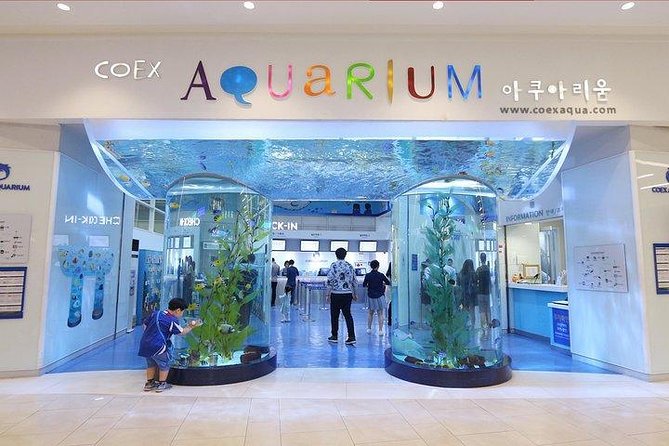
Because the meeting area is in the Gangnam orbit near COEX Center, you can pair this class with other nearby activities without losing half a day to travel. If you are already spending time in Gangnam for shopping, cafés, or K-contents, this studio experience becomes an easy add-on.
That also means you do not have to choose between “K-Pop culture” and “normal Seoul.” You can do a studio class, then go right back to exploring around Seoul’s busiest entertainment district.
One practical caution: since this is a short, scheduled experience (about two hours), you will want to plan your day so you are not rushed. Studio time is fixed time. You want buffer time for subway navigation, coffee, and one quick check of your meeting directions.
Price and value: what you’re paying for at $109
At $109 per person for about two hours, the price is not the cheapest activity in Seoul. But you should look at what you are buying: studio access plus guided coaching plus the hands-on production work.
You are getting:
- Professional studio setting
- English interpretation
- Lyrics and accompaniment support, with Hangul and romanization
- A structured workflow that covers producer, singer, and sound engineer roles
- Your own recorded and worked-on song output
If you compare this to generic museum-style or performance-only K-Pop activities, the value looks better fast. You are not just observing. You are creating something while learning how production actually works.
One detail that points to value is that this class is designed for visitors to participate. If it were just a production workshop for pros, the language support and simplified singing materials would not matter as much. Here, they matter because they help non-Korean speakers get through the creative steps and still feel successful.
Another smart indicator: the experience is often booked about 19 days in advance on average. That doesn’t mean you must rush, but it does suggest the studio session has limited capacity and a tight schedule. If you have fixed travel dates, booking earlier is a good way to avoid missing out.
Who should book this K-Pop making class, and who might not love it
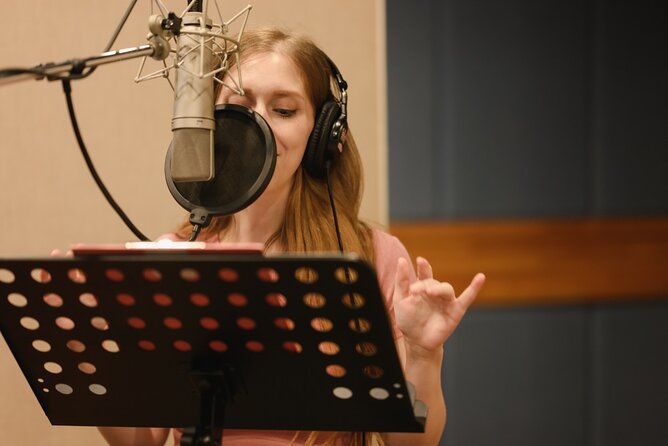
This is a strong fit if you:
- want a hands-on Seoul experience that feels modern and creative
- enjoy music, even if you have never studied recording or mixing
- want English guidance while singing in Korean
- like structured activities with clear outcomes in a short time
It is also great for birthdays or group trips, since it is a private setup where only your group participates. That privacy matters when you want everyone to get chances in the studio workflow instead of getting lost in a larger crowd.
You might want a different option if you:
- dislike being scheduled on the clock, because punctuality is important
- expect a long, open-ended “make anything” creation session, since this is built around pre-selected songs and a two-hour studio process
Practical tips to get better results during your two hours
These tips are based on the way studio classes like this run, and on the specific support described for this one.
- Arrive early enough to calm your nerves. In a studio, confidence affects sound.
- Use the romanized lyrics actively. Don’t ignore them and hope you figure it out by ear.
- Listen to your first playback closely. Your performance will improve faster once you hear what the recording system is doing.
- If you have questions for the producer or sound engineer parts, write them down before you go. Studio time moves quickly.
- If you are choosing between pack options, match it to what you want most: group song experience, more production involvement, or potential video-style output.
And yes, check your route once before you leave. The Seolleung instructions are clear, but you will still move faster if you look up where Dunkin Donuts and 7-Eleven are on your exact walking route.
Should you book KING STUDIO’s K-Pop Making Class?
If you want a Seoul activity that mixes fun with real skills, I think this is a very solid booking. The experience is built around participation, not observation, and you get structured help in English while singing using lyrics in Hangul and romanization. That combo is the difference between feeling lost and actually getting something done.
The value also holds up because the core output is personal: you record, edit, and mix your own song in a professional K-Pop studio environment. For $109, that is not just a novelty. It is a short creative project with tangible results.
So if your goal is a memorable, music-focused experience that still feels approachable for non-Korean speakers, book it. If you prefer purely sightseeing time or you hate the idea of scheduled studio work, then you might choose something lighter.
FAQ
How long is the K-Pop Making Class at KING STUDIO?
The class is about 2 hours.
Where does the experience take place in Seoul?
It takes place at KING STUDIO in the Seolleung area. The meeting point is listed as 52 Samseong-ro 75-gil, Gangnam District, Seoul. Directions from Seolleung Station Exit 1 are provided, including going upstairs and reaching a basement studio entrance in front of a 7-Eleven.
What is included in the class?
It includes accompaniment and lyrics (Korean and romanized), plus professional interpretation in English.
Do I sing in Korean?
You can. Lyrics are provided in Hangul and romanized text, and the staff supports singing in Korean.
What do I do during the session?
All participants take part in the singer, producer, and sound engineer roles. You record, edit, and mix your own song.
Is this a private experience or do I share with others?
It is private. Only your group participates.
Do I need to be on time?
Yes. You must enter at the appointed time, and punctuality is required.
What is the cancellation policy and what if it is canceled due to weather?
Cancellation is free. You can cancel up to 24 hours in advance for a full refund. If poor weather causes cancellation, you are offered a different date or a full refund.
Do I get a mobile ticket?
Yes, the experience includes a mobile ticket.
More Workshops & Classes in Seoul



More Tour Reviews in Seoul


Not for you? Here's more nearby things to do in Seoul we have reviewed


Seoul K-Pop & Hallyu Tours, compared.
 ★ 5.0Full Day Tour In The Soop BTS Ver in PyeongChang Filming LocationFrom $1381,709 reviews
 ★ 4.6From Seoul: Nami Island, K-drama Garden & Rail Bike Day TourFrom $61724 reviews
 ★ 4.8The Painters Live Art K-pop Dance Show TicketFrom $24708 reviews
 ★ 4.9MBC Insider Live K-Drama Rehearsal & VIP Studio TourFrom $101208 reviews
 ★ 5.0ARMY Must Visit BTS Tour in SeoulFrom $48149 reviews
 ★ 4.9From Seoul: Dae Jang Geum Park Historic K-Drama Set TourFrom $55143 reviews
 ★ 4.9BTS K-Pop Star Footsteps Journey ARMY Fan Day TourFrom $77115 reviews
 ★ 5.0K-pop Dance Class in Seoul (Incl. video shooting & editing)From $5452 reviews
Browse the lists this tour appears in